Save First, Spend Later: Inside Jay’s Money Habits
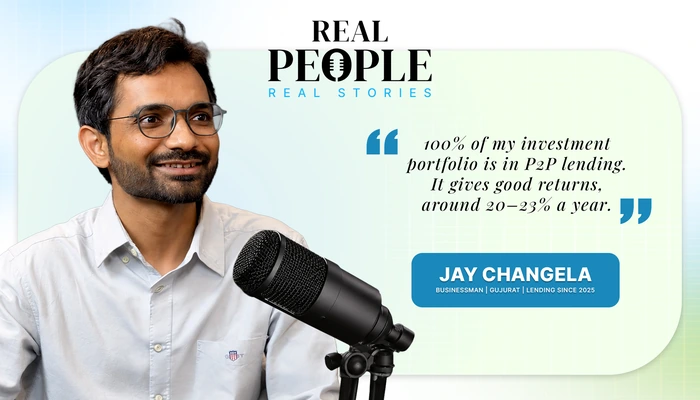
This wasn’t scripted. Jay doesn’t just lend through P2P (peer-to-peer lending) and has thought through his approach in considerable detail. It’s not a practice we would recommend everyone take up wholesale, and we’ll explain why later. But his story is a good one to understand the thinking of one lender when it comes to money, planning, diversification and risk.
Here’s what he had to say.
Money as power, and responsibility
When asked how he thinks about money, Jay had no hesitation. It’s a kind of power. Rajat finished the thought for him: with power comes responsibility, and Jay agreed.
For Jay, it’s about what you can do with it, partly because his upbringing taught him to think about money in this way. He says money was discussed openly at home. Right from how to arrange it, where to lend it, how other options work, and what historic earnings one might get. Most of the Indian households treat money as a private, slightly embarrassing subject. Jay grew up with the opposite, and it shows in how deliberately he talks about his finances today.
Set aside first, spend later
As incomes grow, it’s common for expenditure to grow right alongside it. Better phones, bigger cars, more eating out. Jay’s experience has gone the other way. When he earns more, he sees it as a chance to put more of it to work (literally, in his case).
His rule is simple. Keep some of it aside, and then you can spend the rest. The split is staggering. Jay puts about 80 per cent of his income to build wealth and lives on the remaining 20.
That won’t suit everyone. Family responsibilities, EMIs, rent and life stage, all shape what’s realistic for each person. But the principle of paying your future self before your present self holds regardless of the exact percentage.
From fixed deposits to P2P lending in India
Jay started making his savings around 2020, and began with small amounts from his salary and parking them in fixed deposits. Like millions of Indians, FDs were his starting point because they were familiar and straightforward.
Over time, he grew a bit uneasy with the idea that his money was actually barely growing when viewed through the lens of inflation. He kept that worry with him, and it’s one of the reasons he began looking to other options, and eventually towards an alternative asset class.
About a year and a half ago, he came across P2P lending in India through a YouTube ad, and didn’t sign up right away. Instead, he spent roughly a month studying (watching explainers, learning how the peer-to-peer lending model works and who sits on each side of a loan), and was convinced by the regulation. LenDenClub (an NBFC-P2P lending platform) is registered with the Reserve Bank of India. The registration is the trust factor he felt he needed, and is worth noting that although the platform is regulated, the RBI does not assure repayment of loans, and lenders still bear the credit risk.
He started with ₹1 lakh in this alternative asset class, and watched it behave over the first month, then three months, and only then increased the amount he lent.
How Jay lends: manual, granular, rotated daily
Jay lends manually rather than using a lumpsum option. Using the LenDenClub platform’s filters, he chooses loans himself. In his experience, it’s the difference of about one to two per cent in earnings between the two approaches.
His approach to peer-to-peer lending is based on spreading his money out thin, across a very large number of borrowers. He typically lends between ₹250 and ₹1,000 to each borrower, and his portfolio is now spread out across thousands of borrowers.
He also rotates his money. As repayments come in, he re-lends the principal almost every day, so his funds spend as little time in limbo as possible.
This is the part of Jay’s approach most lenders can learn from. When each borrower only has a tiny fraction of your total money, a single default has limited impact on the overall portfolio. Diversification across borrowers doesn’t take away risk, but it does help manage it, which is the logic behind a diversified portfolio.
Facing defaults head-on
Jay is realistic about defaults. He doesn’t expect every borrower to repay. He’s seen defaults of about four and a half to five per cent in his own portfolio, and considers that manageable.
He described his own historical earnings, after accounting for defaults, to be in the range of 20 to 23 per cent a year. It’s the experience of one lender, shaped by his lending choices and period of time. It’s not a projection or a guarantee of what any other lender will experience going forward.
What stands out is the mindset. Defaults are a part of P2P lending, and it’s the lenders who bear that risk, not the platform. Jay goes in expecting them, and builds his approach around them, rather than being surprised when they happen.
Lending with a purpose
When asked whether Jay thinks of P2P lending purely as a means to earn, or also as a means of helping people who need funds, his answer was that both. Behind each loan, there’s a real person who needed money for something important. For Jay, earning from peer-to-peer lending and helping a person don’t clash.
His conviction has also spread to the people around him. Friends and family have started peer-to-peer lending, largely on word of mouth, and began with around ₹1 lakh each. It mirrors his own approach of starting small, understanding how it works and then growing from there.
Why 100 per cent isn't our playbook
Here we need to be straightforward. Jay’s story is genuine, and we respect the thinking behind it. But there’s risk in putting your entire portfolio into any single asset class, P2P included.
P2P lending in India carries risk. Borrowers can default, and lenders can lose some of their principal and interest. LenDenClub is a P2P lending platform that connects lenders and borrowers. It does not guarantee repayment or protect capital. Past earnings do not predict future earnings.
That’s why we consider P2P lending to be a part of a diversified portfolio, and not the whole of it. Its strongest case as an alternative asset class is that it’s non-market-correlated (doesn’t move with the Sensex), which makes it a useful diversifier for equity, mutual funds and other assets. Interestingly, the best money advice Jay says he ever received is to have more than one in your pocket so you can diversify.
Jay also shared his views on the stock market and gold. He said markets felt uncertain to him, and gold prices looked overheated. Those are his personal opinions, and nobody can predict where either is going. But they’re worth considering alongside your own research.
Jay's advice for someone starting out
For a 25-year-old wondering whether P2P lending in India is right for them, Jay suggests starting with ₹1 lakh. In his view, that’s enough to spread across many loans and enough to build trust in the P2P lending platform before committing more.
His other advice is to save aggressively from your income and put a large share of it into P2P lending. We’d add one caveat. How much you should allocate should depend on your goals, your time horizon, your other commitments and the risk you can afford to take. For most people, a small, deliberate allocation to an alternative asset class within a diversified portfolio is a sensible place to start
Final Thoughts
Jay’s story stands out because he talks about money openly, saves first before spending, did his research before he lent, started small, spread his money across thousands of borrowers, and accepts defaults as a part of the deal.
The given habits are worth borrowing for, whatever your own allocation is. Treat P2P lending in India as one considered part of a wider plan, go in with your eyes open to the risks, and let your own goals (not anyone else’s percentages) shape how much belongs in your diversified portfolio.

Team LenDenClub
LenDenClub is India’s largest peer to peer lending platform which started operations in India in 2015. We have been helping lenders diversify their portfolio beyond traditional investment instruments ever since.