How Anchoring Bias Affects investment Decisions
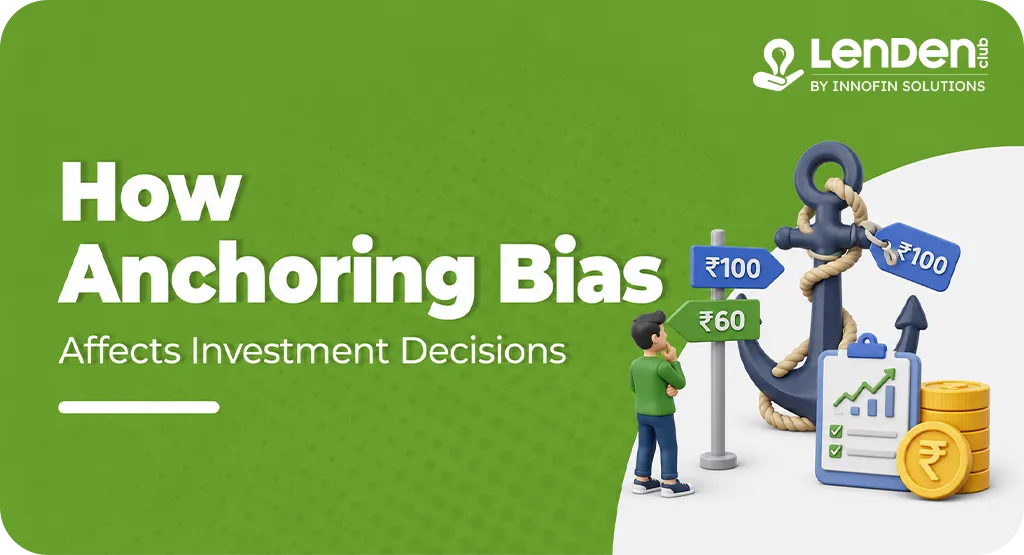
Imagine someone tells you a stock once traded at ₹2,000 and is now available at ₹1,200.
Instantly, ₹1,200 starts feeling “cheap.”
Or imagine you invested in an asset expecting 15% returns, and now anything lower feels disappointing, even if the risk-adjusted outcome is perfectly reasonable.
This mental shortcut is called anchoring bias. In P2P lending, lenders often become emotionally attached to:
- A past return
- An expected earning rate
- A previous portfolio performance level
- A number they saw first
Once that anchor forms, it quietly influences future decisions, even when circumstances change.
Anchoring bias affects everyone, from first-time lenders to experienced professionals. The difference is simply whether they recognise it.
What Is Anchoring Bias?
Anchoring bias is a behavioural finance concept where people rely too heavily on the first piece of information they receive when making decisions.
That initial number becomes a “mental anchor.”
After that:
- Every future comparison happens around it
- Rational judgment becomes harder
- New information gets interpreted through that anchor
In finance, this can affect:
- Buying decisions
- Selling decisions
- Risk perception
- Portfolio allocation
Simple Examples of Anchoring Bias
Example 1: Stock Price Anchoring
A person sees a stock fall from ₹1,500 to ₹900.
Instead of analysing:
- The company’s fundamentals
- Current market conditions
- Whether the stock is fairly valued
They focus only on one thought:
“It used to be ₹1,500, so ₹900 must be a bargain.”
The previous price becomes the anchor, influencing their decision even if the company’s situation has changed.
Example 2: Return Expectation Anchoring
A person earns unusually high returns during a strong market cycle.
As a result:
- Normal market returns start to feel disappointing
- Stable investment options seem less attractive
- They may take on more risk in pursuit of similar returns
In this case, past returns become the anchor, shaping expectations for future financial decisions.
Why Anchoring Is So Dangerous in Lending
The problem with anchoring is that financial conditions, borrower profiles, and market dynamics are constantly changing.
However, lenders who become anchored to past outcomes often:
- Refuse to adjust their expectations
- Overlook changing risks
- Hold underperforming exposures for too long
- Pursue unrealistic return expectations
This can lead to:
- Poor portfolio allocation
- Emotion-driven lending decisions
- Excessive exposure to higher-risk opportunities
Over time, the damage often comes not from a single bad decision, but from a series of distorted decisions influenced by outdated assumptions.
How Anchoring Affects Portfolio Construction
Anchoring does not only affect individual investment decisions. It can also influence how people build and manage their portfolios.
Common examples include:
| Anchor | Behaviour Created |
| “FDs used to give 9%” | Reluctance to adapt to a lower interest rate environment |
| “Crypto doubled last year” | Unrealistic return expectations |
| “This asset never falls” | Underestimating risk |
| “I bought it at ₹X” | Emotion-driven holding decisions |
When investors become anchored to past experiences or reference points, they may struggle to evaluate opportunities objectively and adjust their portfolios as conditions change.
This is why behavioural discipline is just as important as financial knowledge.
Anchoring Bias in P2P Lending
Anchoring can also influence how people approach P2P lending.
Example 1: Chasing Only High Interest Rates
Some lenders see one high rate and assume:
Higher rate = automatically better outcome
But they may ignore:
- Borrower quality
- Diversification
- Risk category balance
- Default probabilities
The rate becomes the anchor instead of portfolio behaviour.
Example 2: Unrealistic Earnings Expectations
If someone enters P2P lending expecting very high earnings every month, they may become disappointed by:
- Normal repayment variability
- Delays
- Portfolio fluctuations
This can lead to reactive decisions instead of disciplined long-term participation.
Why Smart Lenders Avoid Single Anchors
Experienced lenders rarely make decisions based on:
- A single number
- One market phase
- One past experience
Instead, they focus on:
- Process
- Portfolio structure
- Risk-adjusted decision-making
- Long-term consistency
This is because good lending is rarely about a single data point. It is about understanding the broader context and making decisions based on a complete picture.
How to Reduce Anchoring Bias
Anchoring bias never disappears completely, but it can be managed.
Practical ways to reduce it:
1. Focus on Current Reality, Not Past Numbers
Ask:
- What are today’s conditions?
- What risks exist now?
instead of comparing everything to the past.
2. Think in Portfolio Terms
Avoid evaluating assets in isolation.
A strong portfolio combines:
- Stability
- Growth
- Income diversification
rather than chasing one “perfect” opportunity.
3. Use Diversification as a Discipline Tool
Diversification naturally reduces emotional concentration around one idea or expectation.
4. Avoid Emotional Benchmarks
Your portfolio does not need to outperform every market story you hear online.
Consistency often matters more than extremes.
Why Anchoring Is Especially Common in India
Indian lenders often grow up around:
- Fixed deposit culture
- Gold price conversations
- “Property always goes up” beliefs
These long-held assumptions can become powerful anchors that influence future financial behaviour.
But modern portfolios require flexibility.
As economic conditions evolve, lender thinking must evolve too.
The Difference Between Anchoring and Discipline
It is important not to confuse long-term discipline with emotional attachment to outdated assumptions.
Discipline means:
- Following a structured process
Anchoring means:
- Refusing to adjust despite changing circumstances
The difference is subtle, but extremely important.
Anchoring bias affects almost every lender at some point.
Whether it is:
- A past stock price
- A previous FD rate
- A target return
- A market high
That first number can quietly shape future decisions more than it should.
The best lenders are not those who avoid emotions completely. They are the ones who recognise when emotions are influencing their judgment.
In lending, the ability to update your thinking is often more valuable than the first opinion you formed.
FAQs
- What is anchoring bias in lending?
Anchoring bias occurs when lenders rely too heavily on an initial number or piece of information when making financial decisions. - Why is anchoring dangerous for lenders?
It can distort risk perception, create unrealistic expectations, and lead to poor portfolio decisions. - Can anchoring affect P2P lending decisions?
Yes. For example, lenders may focus primarily on high interest rates while overlooking diversification and borrower quality. - How can lenders reduce anchoring bias?
By focusing on current conditions, maintaining proper diversification, and following a structured portfolio approach. - Is anchoring bias common among experienced lenders as well?
Yes. Behavioural biases affect almost everyone. The key difference is awareness and discipline.