P2P Lending and Traditional Instruments: Outsmarting Inflation in 2025
For years, Indian investors have relied on familiar financial instruments, including FDs, RDs, gold, PPF, government schemes, real estate, and mutual funds. These products offered comfort, predictability, and long-standing trust. But as inflation rises and financial needs evolve, many individuals are exploring newer, digital-first avenues that offer better liquidity, easier access, and consistent earnings.
Among these other alternative asset classes, one emerging option, Peer-to-Peer lending (P2P lending), stands out, especially for those seeking regular earnings and predictable cycles without exposure to market volatility.
How P2P Lending & Traditional Instruments Work For Modern India
Traditional financial instruments such as FDs, RDs, PPF, government schemes, gold, real estate, bonds, and mutual funds have long been the backbone of Indian financial planning. They are familiar, well-regulated, and widely trusted. However, with rising inflation and more dynamic financial needs, relying only on these options may not offer the flexibility or earning potential they now look for.
P2P lending, on the other hand, introduces a modern, digital-first way to lend money directly to credit-assessed borrowers through online platforms. It operates as a distinct and alternative asset class designed for today’s evolving financial landscape.
How P2P Lending Works:
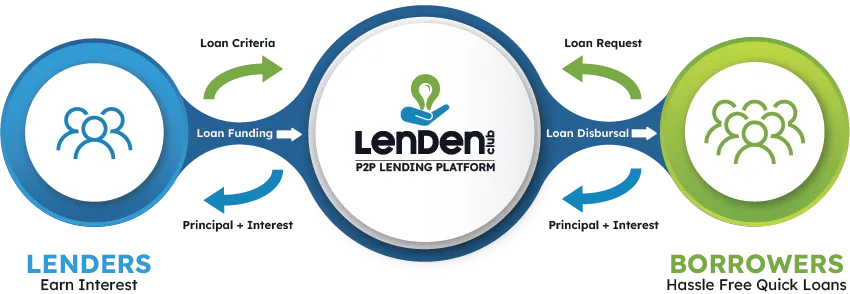
Individuals lend money to verified borrowers through RBI-regulated digital platforms.
Platforms such as LenDenClub manage:
- Borrower verification using AI and data signals
- Credit assessment based on financial behaviour and repayment capacity
- Repayment tracking and collection in case of delays
- Lenders monitor everything through a digital dashboard with complete transparency.
- P2P earnings come from borrower repayments and are not linked to market movements, making it different from market-dependent products.
This structure, technology, and digital convenience position P2P lending as a modern asset class suited for individuals looking to diversify beyond traditional instruments without replacing them.
Returns vs Earnings: How the Two Worlds Work
When choosing between traditional financial products and P2P lending, one major difference lies in how money comes back to you. Traditional instruments generate returns based on market performance or fixed interest structures, while P2P lending creates earnings through borrower repayments.
Traditional Instruments and Their Expected Returns
Traditional financial instruments have long been trusted for their stability and predictable structures. Here’s a quick look at the typical earnings they offer.
| Instrument | Typical Range |
| Fixed Deposits (FDs) | ~5–7% |
| PPF | ~7% |
| Government Schemes | ~6–8% |
| Mutual Funds | Variable & Market-linked |
The challenge here is that inflation often ranges between 5–7%, which reduces the real value of returns, especially in low-yield options.
P2P Lending and Earnings: How Lenders Benefit
On P2P platforms, lenders earn interest from borrowers as EMIs come in. Historically, lenders have earned around 10–15% annually on average, depending on various factors such as borrower category, diversification, and tenure choices.
These earnings are not market-linked, making P2P a differentiated asset class for those who prioritize consistency and cash flow. Shorter cycles also allow lenders to re-lend quickly and build compounding income over time.
Risk Comparison: What You Should Understand
Every investment & asset class comes with some level of risk. Some are steady, some move with the market, and some depend on the borrower. Understanding these risks makes it easier to decide where your money actually fits.
Traditional Instruments
Traditional products are familiar and widely used, but each comes with its own risk profile:
- FDs, RDs, and PPF: These are generally considered low-risk because their structures and payouts are predefined. They suit individuals who prioritize stability over flexibility.
- Mutual Funds & Equity: These are directly linked to market movements. Their value can rise or fall sharply depending on market conditions, making them mid-to-high risk options.
- Real Estate: While popular, real estate carries both market risk (property value fluctuations) and liquidity risk (long timelines to sell or exit).
P2P Lending
P2P lending operates differently and comes with its own primary risk: borrower default risk, the possibility that a borrower may delay or fail to repay. Modern digital platforms, however, work to minimize this risk through structured processes:
- Rigorous credit assessment of borrowers before allowing them on the platform
- Use of multiple data points and AI-driven evaluation to understand borrower behaviour more accurately
- Diversification tools allow lenders to spread small amounts across many borrowers. On platforms like LenDenClub, Lenders can diversify as low as ₹ 250 per borrower.
- Transparent dashboards, enabling lenders to track repayment behaviour and performance in real time
Additionally, all recognised P2P platforms operate under RBI’s NBFC-P2P regulations, which define clear rules for governance, disclosures, and fund flow. So, while P2P lending is not entirely risk-free, the risk can be diversified and balanced through smart diversification.
Liquidity, Where the Real Difference Lies
When it comes to investing, returns matter, but liquidity decides how much control you actually have over your money.
Traditional Options
Traditional investments usually come with long lock-ins or withdrawal restrictions. PPF runs for 15 years, government schemes have strict exit rules, FDs charge penalties for breaking them early, and real estate is simply hard to sell quickly. These factors make traditional options stable but not very liquid.
P2P Lending
P2P lending, on the other hand, operates on shorter cycles, typically 2 to 12 months and offers monthly or daily repayments. This keeps your cash moving, allowing you to re-lend regularly or access funds when needed without long waiting periods.
Moreover, P2P platforms are fully digital, making the experience smoother and faster. Everything from onboarding to tracking earnings happens online.
What makes it simple:
- Earnings are directly transferred to your bank account
- Quick online signup & dashboard access
- Borrower insights in one place
- No paperwork at all
- Instant access to earning history
Transparency is a Key Advantage for P2P Lending
While traditional options like mutual funds or real estate sometimes lack complete visibility due to market changes, P2P platforms offer:
- borrower details
- repayment behaviour
- portfolio performance
- platform-level metrics
This gives lenders full clarity into where their money is lent and how it is performing.
Both Instruments Are Well-Structured
Traditional instruments fall under RBI, SEBI, and various government bodies, which is why they are trusted and widely used. Similarly, P2P lending operates under RBI guidelines, which clearly define:
- All lender–borrower transactions must move through bank-managed escrow accounts.
- Platforms cannot sell or promote any guarantee-based or credit-enhancement products.
- Lenders exceeding ₹10 lakh across platforms must submit a CA-certified net worth of ₹50 lakh.
- Lenders must formally confirm they understand all associated risks, including potential principal loss.
- Platforms must display their registered name clearly across all communication and interfaces.
P2P lending suits those seeking regular cash flow, non-market-linked cycles, digital convenience, and diversification with calculated risk. Those prioritising long-term, government-backed stability may stick to traditional options. A balanced approach works best: traditional products for stability, P2P lending for monthly earnings and liquidity and non-market linked earning, creating a modern, flexible portfolio.
P2P lending represents a modern, digital-first approach to lending that complements traditional financial instruments. It allows individuals to lend directly to credit-assessed borrowers, track repayments digitally, and participate in shorter, non-market-linked cycles. While it comes with risks such as borrower defaults, proper platform selection, diversification, and adherence to RBI guidelines help manage them effectively.
FAQs
Lending money directly to verified borrowers via digital platforms and earning interest as they repay.
P2P earnings come from borrower repayments (10–15% historically), not market fluctuations, and offer faster liquidity.
Mainly borrower defaults. Platforms reduce this with credit checks, AI, diversification, and RBI regulations.
Yes. P2P returns are often higher than inflation if followed by the right strategy, like diversification and compounding earnings.
A mix works best: traditional instruments for stability, P2P for regular earnings and liquidity.

Team LenDenClub
LenDenClub is India’s largest peer to peer lending platform which started operations in India in 2015. We have been helping lenders diversify their portfolio beyond traditional investment instruments ever since.