Gold vs. SGB vs. ETFs: The 10-Year Post-Tax Truth
If you grew up in India, you’ve probably heard some version of this advice: “Buy gold. It’s an investment and the best one there is.” For many families, gold, especially when bought as jewellery, has long been synonymous with wealth creation. It’s ingrained in our culture, and being able to hold it in your hand is emotionally reassuring.
That said, when you look at the numbers, something surprising happens. Take 10 grams of 24K gold purchased in 2015, for example. The average price that year was around ₹26,343 per 10g. In 2025, the same 10 grams would be valued at roughly ₹1,36,662.89 (as of 17th Dec, 2025). Basically, gold prices have increased by approximately 418.8% over the 10 years. On the surface, this looks like a strong gain. Most stop there and assume that their wealth grew more than fourfold.
Unfortunately, this headline number ignores everything you, as a consumer, actually pay for and lose along the way, i.e., making charges, pre-GST taxes, storage costs, buy-sell spreads, purity deductions, and resale friction. Once you account for those, the math tells a very different story.
To understand that difference clearly, in this post, we’ll compare three ways of holding gold –
- Physical gold/jewellery
- Gold ETFs
- Sovereign Gold Bonds (SGBs)
Now, although you can no longer invest in SGBs as they are no longer being issued, millions of Indians still hold them. This is why it has been included in this comparison to further highlight why and how physical gold falls short as a long-term investment.
The goal is not to dismiss tradition but to help you separate emotion from the math so that you can make wiser choices with your money.
Why Gold Returns Aren’t What You Think
The biggest misconception about gold jewellery is simple: people believe that if gold prices go up by 280%, the value of their jewellery bought as an investment does too. Unfortunately, that’s not how the numbers in the real world work.
When you buy jewellery, you’re not buying just gold. There are several other expenses involved.
In 2015, gold purchases were taxed under the pre-GST regime, which included –
- Import duty (≈10%)
- Excise duty (≈1%)
- VAT (≈1.2%)
This pushed the effective tax burden on gold jewellery to roughly 12–13%. In addition to this, you also need to account for the following –
- Making charges – Typically 7–25% of the gold value
- Wastage charges – Depending on purity and workmanship
- GST on resale (post-2017) – Depending on the buyer
The expenses don’t just end here. You also need to consider –
- Bank locker fees
- Insurance (optional but recommended)
- Purity deductions when selling (e.g., 1–3%)
- Reduced buyback price from most jewellers
This is how it translates to your actual purchase.
Let’s stick to the same 10g worth of jewellery bought in 2015:
- Value of the gold – ₹26,343
- Making charges (say 15%) – ₹3,951
- Pre-GST duties + VAT (~12.2%)- ₹3,212
Total cost paid – ₹33,506
See the immediate difference? When you go to sell this very piece of jewellery, you do not recover the making charges. You only recover the value of the gold content itself, minus the additional expenses listed above.
This is why jewellery belongs in the “consumption” bucket, not the “investment” bucket.
Gold Jewellery vs. ETFs vs. SGBs: What Happens Over a Decade?
To give you an accurate comparison, let’s see how investing in gold jewellery stacks up against investing in Gold ETFs and SGBs over a period of 10 years. Before we do, let’s quickly compare these options on the surface:
| Aspect | Gold Jewellery | Gold ETFs | SGBs |
| Making Charges | Between 7-25% | None | None |
| Storage Cost involved | Average locker fees: ₹1,200 – ₹4,000 for a small annual locker.₹4,000 – ₹15,000 for the large ones | None | None |
| Interest Earned | None | None | 2.5% anually |
| Applicable Taxes | Long Term Capital Gain Tax (LTCG) | LTCG + Indexation | Tax Free on Maturity |
| Liquidity | Medium | High | Low – Medium |
As you can see, gold jewellery isn’t stacking up well here. Now let’s apply some real-world math to this scenario.
To be accurate, let’s work with the same figure for 10 grams of gold: ₹33,500 in 2015 (the approximate cost of buying 10g of jewellery, including making charges + duties). (The actual value of gold you pocket is only ~₹26,343)
If you had invested in Gold ETFs and SGBSs, the entire ₹33,500 would have gone into the value of the gold, i.e around 12.5 grams of it.
Now, let’s see how this investment plays out over the next 10 years.
Gold Jewellery After 10 Years
You paid ₹33,500, but only received ₹26,343 worth of gold. Over the last decade, the prices of gold have gone up by approximately 3.85× their value since 2015.
- Total value of your gold today: ₹26,343 × 3.85 =₹1,01,420.55
- If you sell, jewellers deduct about 4%: ₹1,01,420.55 – 4% = ₹97,363.72
Your initial ₹33,500 investment is now worth ₹97,363.72.
Gold ETFs After 10 Years
Your initial investment was ₹33,500, and this is your gold exposure.
- Total value of your gold today: ₹33,500 × 3.85 = ₹1,28,975
- Subtract ETF expense ratio (~0.75% p.a. x 10 = ~7.5%): ₹1,28,975 – ₹9,673.12 = ₹1,19,301.88
Your initial investment of ₹33,500 in Gold ETFs is now ₹1,19,301.88.
SGBs After 10 Years
Your gold exposure is the same as ETFs, i.e ₹33,500.
- Total value of the gold today: ₹33,500 × 3.85 = ₹1,28,975
- 2.5% annual interest for 8 years: ₹33,500 × 2.5% × 8 = ₹6,700
Your investment via SGBs after 10 years is ₹1,28,975 + ₹₹1,35,675.
The Side-by-Side Comparison
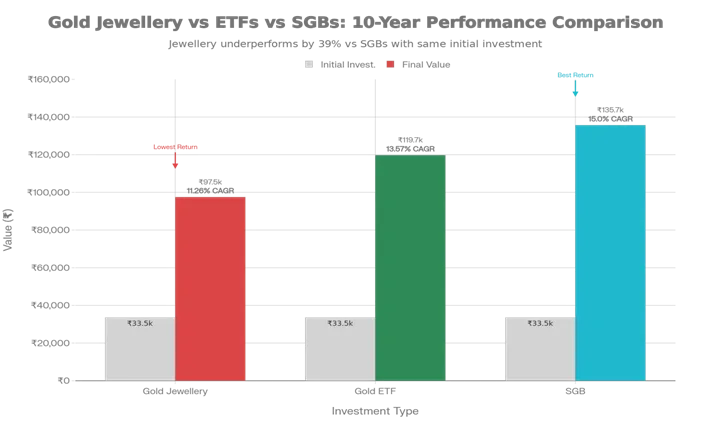
₹33,500 invested in jewellery yields ₹97,460 versus ETF’s ₹1,19,700 and SGB’s ₹1,35,675 after 10 years
If you tabulate the above values and calculate the XXIR, you get
| Instrument | Initial Investment | Final Value | XXIR |
| Gold Jewellery | ₹33,500 | ₹97,460 | 11.26% p.a |
| Gold ETF | ₹33,500 | ₹1,19,700 | 13.57% p.a |
| SGB | ₹33,500 | ₹1,35,675 | 15% p.a |
Gold jewellery suffers from built-in friction, high making charges at purchase and value deductions at resale, along with storage and liquidity costs. These expenses reduce your effective gold exposure, causing long-term returns to lag paper gold options despite similar price movements.
Math Doesn’t Lie
When you separate tradition and mathematics, it becomes clear that, as a financial instrument, gold jewellery is not very efficient. So what do you do? If you already hold SGBs, keep them until they mature. If you want the best bang for your buck in terms of investment, go with ETFs. If you want jewellery, buy it, but only to be worn, and not as an investment.
When the topic of sensible investment is discussed, another key topic is diversifying a portfolio. If this comparison proves one thing, it’s that no single asset meets every financial objective. Gold has its place, but meaningful long-term growth often comes from spreading your capital across varied opportunities.
This is where alternative lending platforms like LenDenClub can complement a portfolio. As an RBI-regulated P2P lending platform, LenDenClub offers exposure to non-market-linked returns, with the ability to start small and diversify across multiple borrowers. Even allocating a modest percentage to such alternatives can help smooth volatility and create more balanced long-term outcomes.
Connect with us now to know more.

Team LenDenClub
LenDenClub is India’s largest peer to peer lending platform which started operations in India in 2015. We have been helping lenders diversify their portfolio beyond traditional investment instruments ever since.