From Sceptic to Lender: What Two Months of Research Taught Rahul
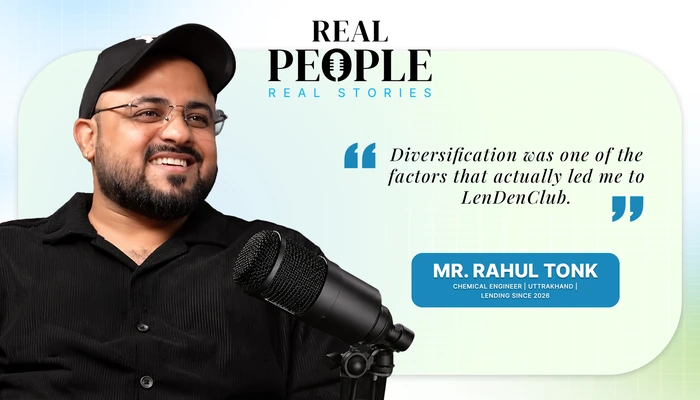
Who is Rahul Tonk?
How Rahul's Investment Journey Began
How Rahul Built a Diversified Portfolio
Lessons From Market Losses: Why Patience Matters
How Did This Apply to Rahul's P2P Lending Experience?
Patience was not part of Rahul’s P2P lending journey, at least not right away. He had first heard of the idea of P2P lending earlier but never paid any attention. If a video or post on P2P lending appeared on YouTube or social media, he would not hesitate to scroll it down.
“I was not comfortable at all with this lending business.”
It is important to understand that money lending in small towns and cities is largely informal. There is no regulation or control, and lenders charge interest rates on the borrowed sums to make a living. It is a high-risk, high-reward venture.
Rahul was not convinced because he felt such an environment carried a very high possibility of damaging personal relationships as people would lend money to friends and family. What changed his perspective was understanding how LenDenClub operates as an RBI-registered NBFC-P2P platform, its borrower evaluation process, and the structured approach it offers to P2P lending.
How Rahul Researched P2P Lending in India
The second major aspect that attracted Rahul was the evaluation process that LenDenClub undertakes to assess the credibility of a borrower. Rahul knew that lenders should assess the risk associated with a borrower before considering lending. Borrowers have a CIBIL score and rating, which helps lenders understand the P2P lending risk.
After he registered at LenDenClub, Rahul could evaluate potential borrowers on the rating, their salary and whether they were a salaried worker or a self-employed individual.
Understanding P2P Lending Diversification
Diversification is an important aspect of investing, and Rahul’s journey into P2P lending reflects the same. Rahul was not aware of the concept before researching for the blog post, assuming that peer-to-peer lending was a case of one-to-one lending. What he discovered was that a sum of money could be distributed among multiple borrowers.
“You are not giving to a few people, you are giving to a lot of borrowers.”
How Borrowers are Evaluated on LenDenClub
One of the questions that Rahul had before taking up P2P lending was how his money would be repaid, and whether there was a system in place for tracking borrowers.
Three things reassured him: the documents submitted by borrowers during the registration process, the regulation that LenDenClub falls under and ratings of borrowers.
- The length of the borrower’s credit history
- Existing loans: secured or unsecured
- Bank account statements
- Month-end balances
- Whether their salary is credited on time each month
Starting Small and Re-lending Repayments
Rahul began his P2P lending journey with ₹2,000. He wanted to lend to a single borrower who had a good rating and see if it worked out.
“Within a couple of days, I received the interest,” he says.
The second time, Rahul lent roughly ₹50,000 and continued to lend in small tranches until he had built up his portfolio.
“Within a week of that second lending, my repayment started coming in” he adds.
Rahul also spoke about his experience with re-lending. Every repayment that comes in has a portion of the principal along with the interest. Rahul prefers to re-lend the amount, and not keep it as cash.
“I find it better to keep the money in the system,” he says.
Re-lending repayments allows lenders to deploy their repaid principal and interest into new loans, creating opportunities to continue earning interest as borrowers repay. At the same time, it helps diversify one’s portfolio by spreading out the sums among multiple borrowers, even though every such loan still carries risk. Rahul is five to six months into his P2P journey, and he intends to review his performance after a year has passed.
Rahul's Advice for First-Time Lenders
When asked what he would say to first-time lenders exploring P2P lending, Rahul emphasises the importance of understanding it first.
“When you decide to buy something as simple as a television or a washing machine, you compare several options. Why wouldn’t a financial decision warrant the same amount of attention and research?”
“Pehle samjho dhang se.” (First, understand it properly.)
In practice, that means taking the time to understand how borrowers are evaluated, how repayments work and what the P2P lending risk.
Final Thoughts
Rahul described the last six months of his life as a philosophical change. Before researching P2P lending in India, his money went into the stock market, mutual funds, gold funds and physical gold.
After spending time understanding the model, he finds that he is more open to making more money in P2P lending. What stands out about Rahul’s journey is the sheer amount of time and effort he put into his research. Starting small, diversifying his portfolio and waiting before making another lending are some of the best practices that he learned on his journey.
And, as Rajat points out at the end of the episode, he is not an expert in finance. He is simply narrating his experience so far.
To hear the full story, you can watch Season 2, Episode 1 of Real People, Real Stories on LenDenClub’s YouTube Channel.
Frequently asked questions

Team LenDenClub
LenDenClub is India’s largest peer to peer lending platform which started operations in India in 2015. We have been helping lenders diversify their portfolio beyond traditional investment instruments ever since.